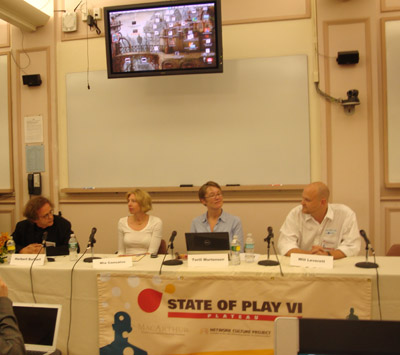
State of Play: Across Cultural Boundaries

Panel on Across Cultural Boundaries

This was a delightful session. The speakers were all great. Here are my notes on the session:

Herbert Burket [German law professor]

Three devices in games that maintain the interest in winning and create a taboo in losing: diversion, avoidance and reinterpretation.

  • Diversion: a game gives you an indication of losing and lets you try again.
  • Avoidance: bringing forward advertising games where you cannot lose at all.
  • Reinterpretation: to reinterpret losing as winning.

There is room for thinking about the losing experience in the gaming world. Rather than giving players the experience of losing but losing is an opportunity to take them out of the game and have a more reflective view of the losing experience. There are three strategies that help deepen the experience of losing:

  • The tragedy games: when a player has an unsurmountable barrier.
  • Winning is losing: eg players upload their friends pics and think they are on their team but end up shooting them.
  • Dependence games: other players constantly redefine what is success and leaves each individual players chasing other goals that other individuals are setting.

Not to dwell on the experience of losing in a game is itself a loss.

Mia Consalvo [MIT]

Western Otaku: games crossing

Globalization.  VW as transnational spaces. People play SL and final fantasy play on shared servers. You can play it on any platform so it is also cross platform. Otaku are fans of Japanese who like Japanese culture. Gives them space to encounter ‘the other’.  Impact on culture?

Spectrum of interests: interest in stories/gameplay; might lead to further interests such as learning language; creates possibilities to be exposed to different people, your beliefs challenged etc.

Torill Mortensen [Norway]

Physical playspace: how do people integrate machines into their lives – especially gamers? Game objects come out of the game – eg. Dragons come out in art and drawing.

Results:

  • The use of game technology is adjusted to the needs of the players, illustrating social structures as much as game structures.
  • Often behaviours overlap mong fields, highlighting cultural synchronicity.
  • If we define vw the way bart simon did as ways of living which are artificially constructed and depend on tech, independent of georgraphy, then the ‘rane’ world
  • The time spent in digital spaces is as real a the time spent in cars.
  • The vw is already in the world.

Will Leverett

What happens when we give people the most sophisticated tools today? Realtimeworlds [will be out in Feb]. Detailed views of avatars – muscles, tattoos, skin color, facial expressions. It also has its own music creator.
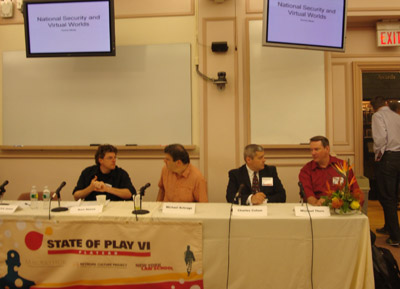
State of Play: Surveillance and Security in VW

Surveillance Panel at State of Play, NY

Very very interesting session on surveillance and security on virtual worlds. I actually thought it would be all about ‘Muslim terrorists’ and I was quite apprehensive, but then found the session to be absolutely fantastic and very informative.

Here are my notes on the session:

Intro from British intelligence: What can they do for bad-guys: Voip, recruitment..

What can it do for good-guys: twitter for example. There was an operation Crevice to bomb London.

Wikipedia, twitter, facebook, vertical content: the possibility of it spilling over in VW is great. Re the future of VWs going to be where warfare is conducted? [e during the Gaza war: Gaza and Israel in SL].

Bart Simon: perfect surveillance – worries about invasion of privacy. Jeremy Bentham and Foucault’s panoptic. It is not about being watched, but it is about a state that requires minimal surveillance. It is about the people watching themselves – they do the surveillance themselves and they start watching and get info about themselves to police themselves. Surveillance is a systematic exertion of influence on someone’s life and the second is systematic attention. People don’t watch people any more. Now we have dataveillance: where data is collected and put in a database. The surveillance is not of the person but the data about that person and the key is to connect the data to the person. It ends when that person ‘confesses’ that you got him. But VWs make that difficult because you disengage who you are from the data about you.

Oscillating between the concept that VWs is dangerous and the concept that it is not. We don’t want their confessions any more but we want their genetic information. When we increase the individuization of avatars people make surveillance easier because they claim their data directly.

Everything in VWs lets you act as who you are not – it encourages role play and encourages you to be someone else – which real life is difficult to do. How do we create a VW where people will not role play? This is for example for marketing projects.

Charles Cohen: is surveillance technically possible? And is it lawful? [a murder case where normally you would talk to friends etc.. and trace behavior, but he spent 20 hrs online and they decided they had to go there to make the investigation]. Distribution and production of child porn. Found in VWs but as it gets more photorealistic it becomes more difficult to prosecute: is this really a child? How to prove that?

Currently it is more of a challenge than an opportunity. What about servers outside US jurisdiction?

Michael Schrage: raises sociological and legal questions. You design honeypots – in VW what constitutes a honey pot where you trap avatars to do get them – which may sound like entrapment. How do you design a honey pot? The issue is how the VW interacts with the real life. The rise is malevolent mashups. VW as media for trust and media for verficiation. Trust but verify as Reagan said. How do you verify?

Creating jihadi bots. Assembling botnets is not that hard.

The evocative aspect is not the evolution of VWs but because of the proliferation of devices we will see grey markets and black markets and improvisation. It will create interesting collaborations in the community.

Michael Theis: the world has changed fundamentally in such a way that people can steal stuff because it is in a computer in some place. It takes 3 things for protection:

1-      An aspect of trustworthiness: what do I trust and who

2-      Right size my permissions: the software does what it is designed to do. Information about them but not give out info about myself.

3-      Effective monitoring capability: not surveillance but monitoring.

We look at people in real life, and see how they would act in cyberspace. Would someone who shares music steal from best buy for example? Not necessarily.

Trustworthiness: looking at people and assessing facial and physical expressions during an investigation. It is difficult to do that in VWs and cyberspace.

People believe in anonymity but it is not true. In voice it is an issue of meter and tone etc.. pausing, the ummms.. Could I do that in VW? Could I ask questions to determine their trustworthiness?

People also act differently in different VWs. Anamiah.. people could take on multiple personalities but then after a while you can tell that the two are the same people.  What is needed is something that identifies those aspects.

We have to consider how we go about doing monitoring.

From the question/answer session:

Could griefers be prosecuted? For example for sexual harassment?

In terms of constitutional law, how much can you do in terms of going into someone’s virtual home? It has to be viewed as an intercept to do that rather than as a search of the home that needs a warrant. Currently the law does not specify that at all. But also that should fall into the laps of the VW owners and their TOS.

State of Play – New York

I am attending State of Play conference in New York. The opening speech was interesting – by the creator of Metaplace. Here are some highlights of what he said:

Raph Koster: A New Kind of World

Where is virtual world’s relevance? Virtual worlds are web 1.0 not even 2.0 not to mention 3.D. Why does the web work today? Because it is open: html, online Mozilla, apache, CGI, CSS, DNS, Google. The biggest underlining assumption is that everyone can do what they want. Virtual Worlds don’t work this way. It is  a network and does not run on a single centralized server. Can they become relevant and can they break out of the plateau? When will VWs become more like the web? Metaplace tries to do that – it leaves open template content, etc. Problem is, we don’t know if anybody cares. What is the killer app for VW? It is wasting time and having fun – not education nor distance collaboration.

Do users care that they are beyond entertainment? What does it mean to build that? How do we evolve our thinking? If we actually give users the ability to work it as the web [not centrally managed, not on a single server etc].. how do we think about commerce? Eulas? Privacy?

Metaplace TOS: gives rights of creators and rights of users unless overridden, responsibilities of creators and users. It is rights of avatars. Freedom of expression, ownership, including earning money and running their own world, privacy, develop their own TOS. The declaration of the rights of avatars is now in place. They told users not to break the law. This was of course challenging.

Could we have this any other way? What areas are public? What things are private? What about people hopping across worlds? Which TOS do they belong to?

Modeling after the web: hotlinking or deep linking for example could it be the same when avatars are actually walking around through links?

Future: what will VWs be?

  • Ambient: are you in your browser frame?
  • Pervasive: what’s the TOS for a widget?
  • Preamble: what’s the privacy policy of a multidirectional stream?
  • Overlays: what’s a world in the first place?
  • Relevant? The new kind of world isn’t this; it’s the new hybrid.

Looking for the new model. Old worlds will not go away but there will be a change. If they are to be relevant, how much can they emulate the web and take down countries [as did Twitter].

NMC: Mobiles in Learning, Socio-Economical Development and Knowledge Work

Talk by Teemu Leinonen [from Finland]

  • Finland has 5.2 million population and 6 million cellular phone subscriptions and 2 million broadband connections.
  • In 2007 Apple Computers Inc. dropped the name Computers and is now Apple Inc. because it does better now with mobile phones.
  • Annually about 1 billion mobiles phones are sold
  • 50% of the world have the basic type of mobile phones

Two trends:

  1. >mobiles and wikis
  2. Mobile wikis
  3. Future of mobiles in learning

Mobiles:

  • phones
  • multimedia phones
  • handheld devices – ipods, games etc.
  • phone computers [eg. Iphone]
  • internet tablets
  • ultralight laptops

Half of the world population will be using mobile phones and multimedia phones and will never reach the other types because they are very expensive.

Entry level mobile phones have:

  • text and talk [sms]
  • clock/alarm
  • calculator
  • torch/flashlight
  • mobile network

They could stand about two weeks without charging.

The Second mobile phone: [multimedia phone – Nokia is best]

  • talk and text
  • music/audio – mp3/FM radio
  • camera: photo and video
  • you can write software for that such as java/python, flash light etc.
  • mobile network – Bluetooth that helps sharing in close networks without much expense

Mobile phone is one-to-one media.

Wikis:

how many have used it? How many have edited articles in wiki?

It currently has 1600 administrators for the English wikipedia. It is global.

Wikis are many to many media.

If we combine them it would be more powerful. Many to many media becomes a forum for discussion and build knowledge together in a certain shared space.

2- Mobile wikis: Mobile Audio Wiki Video

MobilEd in South Africa. It is a mobile initiative. They created an audio encyclopedia.

They tried it out in an educational setting. You can also record your own entries and it creates a podcast for you.

Mobile many to many media?

Why people want to do media? Because they can: they have the tools and time.

3- Future of mobiles in learning:

the ability for more people to talk to each other.

Informal learning: communication, news, ads

Launched in China in 2007 MobilEdu provides wireless learning directly to your device.

Nokia has Nokia Life Tools: access to agriculture, education, entertainment. It was launched in India.

OtaSizzle: ubiquitous social media for urban communities. .Oopen experimentation environment for testing mobile social media services.

Shedlight concept: [shed light application which enables people to place notes] made in a new media and learning workshop 2006 in media lab Heslsinki. You move the phone and take video of the scenes around you and people can connect to it and annotate it.

New Media Consortium 2009 summer conference

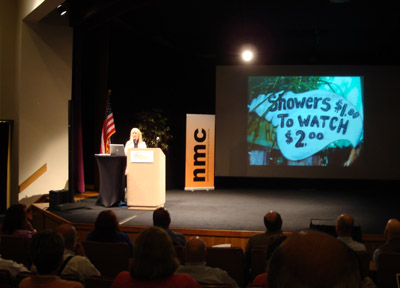
Kathy Siera as NMC Keynote Speaker

I am in Monterey, C A attending this conference. The plenary session was outstanding – the speaker, Kathy Sierra is a charismatic, hilarious and informed speaker. Love the talk. Here are the notes from that session which she called ‘Cognitive Seduction’:

Predictor of success: which is better is it how great the company is or how great the product is? How great the author is, or how great the author is? The answer is C which is talk about the user or the audience or the reader. What the testimonials are.. here is what I learnt from this product. Companies need to learn how to elicit first person language. It is all about how cool the technology is – but really how cool the user is who uses that technology, “What do you want to be really really good at? Imagine if we could actually do that for people. Why is it that the experience of being good at something is so powerful for people? How do you create passionate users? Creating hi-res user experience. Nobody is passionate about things they suck at. There is a suck threshold and a passion threshold.. one goes from beginner to expert. How do you get someone up the curve more quickly from bad to expert?

But it’s not about the tools we build. Don’t focus on the tools – people don’t want to be passionate about how good they are at tools but about what they are able to do with it. Let’s help them get really good at something. Just one problem.. your brain. Your brain and mind are in an epic battle. Brain wants food and sex but mind wants other things. The brain is filtering everything that is coming at it and trying to decide what to let through. The brain pays attention to chemistry: that which we feel., When we feel it we become passionate about it. Look at expressions of people and things and how we react to them passionately. There are many cheap tricks to get the brain to care.

The brain does not react to smiley tablet using computer. The brain does not like code because it is not life threatening. Yes you wake up the brain but sometimes for the wrong feelings.

Conversation beats formal and lecture tone. Talk to the brain not the mind. Using ‘I’ and ‘you’ makes people pay attention more because the brain thinks it is in a conversation.

Ten tricks:

  1. Focus on what the user does, not what you do. Exercise: don’t build a better x but ..
  2. Give them superpowers, quickly. Give them something that empowers them quickly. User must do something cool within 30 minutes.
  3. Make them smarter: what makes you smarter? Brain games? Puzzles? Those help a little – but aerobic exercise improves your brain capabilities. Exercise is the poor man’s plastic surgery.Stand up and improving your balance makes you smarter because the brain is trying to keep you balanced and upright. Those are the kinds of things we need to think for our users.
  4. Don’t focus on X, ask what X is a subset of. Find relevance. What is the bigger thing that your topic is a part of? Eg. Don’t blog about your product but about what people can do with it – it is about cooking, not the tool.
  5. Shrink the 10,000 hours. There are ways to shrink the 10 thousand hours to be good at something: learn the patterns, shorten the duration by helping them do them in a shorter period of time. Create and think in patters and chunking. Learn to do knowledge acquisition. Always be practicing. Create a culture of practice. We expect people to practice [athletes etc], but for software development we don’t have that culture. Only a thousand is needed to be expert. Experience is a poor predictor of performance/expertise. Offer exercises, games, contests, tutorials tht support deliberate practice of the right things.
  6. Make your product or docs reflect their feelings. Reflect the way people are using it. Help and FAQs are not effective. We write it for happy smiley people but not beginners. “Letting people off the hook is the killer app”. People should not be made to feel guilty and bad. How you make them feel about themselves drives how they feel about you.
  7. Create a culture of support. How do you ger them to answer and ask questions? There are no dumb questions. In communities people have to make people feel comfortable asking questions. No dumb answers too. We have to allow people to feel that it is ok to answer wrong. That’s part of how they learn.
  8. Do not insist on inclusivity. Passionate users though talk different. Part of what is cool is to be able to talk in jargon inspite of the presence of newbies.
  9. Make the right thing easy, wrong thing difficult. A treadmill is not in the corner because you don’t use it but you don’t use it because it’s in the corner. Make is easier for users to breakthrough.
  10. Total immersion jams: 16 hours over two days vs. 16 hours over two months. Compressed periods of time are better for creativity breakthroughs. The surest way to guarantee nothing interesting happens is to assume you know exactly how to do it.
  11. Be brave. Love is good, hate is good but in the zone of mediocrity you’re scrwed.