e-Learning: Teachers Count (UNESCO) – WSIS 2011

May 16- 2011: 16:30 – 18:00 hrs- Interactive Facilitation Meeting- C7 – E-Learning: Teachers Count (UNESCO)

Within the framework of Action Line C7 e-learning, this year’s facilitation meeting will focus on the impact of ICTs on teaching and on the role of teachers in applying ICTs in their work. Special consideration will be given to the UNESCO ICT Competency Framework for Teachers (ICT CFT). The implications for governmental policy makers, teachers, and teacher training providers will be discussed, with particular reference to the interaction among the international and national competency standard setters and standards implementers, by probing the following interrelated questions:

  • Are teachers assuming their appropriate roles in enabling effective e-learning?
  • How and to what extent can teachers be groomed to be a qualified e-learning enablers?

Speakers

  • Gonzalez Jose Fernando, Vice Minister of Basic Ministry of the Public Education , Mexico Education
  • Bart Dewaele, Director General VVOB HQs in Brussels
  • Hans Laugesen, International Secretary and Senior Educational Policy Officer, The Danish National Union of Upper Secondary School Teachers, GL, Denmark
  • Fengchun Miao or Mr. Peter Schioler, UNESCO Read More …
re-thinking role of universities

The Post-Humboldtian University: Re-thinking the University’s Role in Society in the Network Age – Juan Carlos de Martin, Co-Founder and Co-Director of the NEXA Center for Internet & Society at Politecnico di Torino & Charles Nesson, Berkman Center for Internet & Society.  Event will be webcast live at 12:30 pm ET on May 17th, and archived on Berkman Center’s site shortly after.

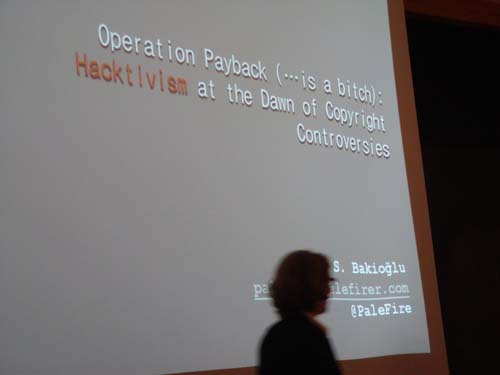
operation payback (..is a bitch)

Pirates session
Burcu Bakioglu, Operation Payback (…is a Bitch): Hacktivism at the dawn of Copyright Controversies
Bodo Balasz, Informal Media Economies – What Can We Learn from the Pirates of Yesteryear?
Martin Fredriksson, The Ideology of Piracy and the Public Spheres of Modernity
Jinying Li, Piracy, Circulation, and Cultural Control in Cyber-Age China
moderator: Marcienne Martin

Unfortunately I was able to attend only the talk by Bakioglu.

  • culture of piracy is what they call copypasta [or copy paste]. It is a subversive culture. Response to it was to extend regulation and limitation of piracy.
  • The ‘culture’ perceived any copyright issues as a threat to creativity, to corruption exposure, privacy, an act of criminalization of society, surveillance.
  • They were a true networked society that was lateral: hoizontal modes of communication presenting alternative strategies of resistance.
  • Sites of struggle: The Pirate Bay. This alternative form of protest took the form of hacktivism. It is non-violent civil disobedience [DDOS attacks, site defacements etc.]
  • It used to be a sub-culture but now it is becoming mainstream.
  • Wikileaks and Assange are a model. Nodes that exchange information and give power. One therefore needs to intercept flow of information and leak it out.
  • Op Payback began when an Indian company was contracted and announced it would take down Pirate Bay [co. called aiplex.com].
  • Case of ACS Law solicitors whose site was taken down and in effort to remedy problem hurriedly put their site back up and inadvertently published secret information that stayed online for two hours and the info proved it was damaging enough to the company because it exposed its illegal dealings.

Forum 2: archives and cultural heritage/memory

Speakers:Frank Marchese, Pace Digital Gallery, Julia Noordegraaf University of Amsterdam, Jason Rhody, Office of Digital Humanities, NEH. Moderator: Nick Monfort, MIT

Summary and Podcast here

Session was basically about how to present literature, art and whatever is or is not archived already – in such a way that it becomes archivable. There is always a need to archive and preserve. Read More …