Find Free Books Online

There are many resources to access free e-books of all genres. Besides wikibooks and archive.org, I had listed a few before.  OpenLibrary is a new one that I found and it also gives free e-books and has a plugin compatible with wordpress. In addition,  the Education Portal created a listed of great resource of free books online in addition to the ones we have posted before. The following is their list:

Free Fiction and Nonfiction Books

  • Authorama – You can find more than 100 free books from a variety of different authors on Authorama. New books are added to the site each month, and they’ve all been translated into plain ASCII or HTML so that no e-reader is required.
  • Book Stacks – Book Stacks hosts tons of ebooks that you can download and read as PDFs.
  • Bored.com – More than 10,000 free books are available at Bored.com. Book categories include but are not limited to: American literature, British literature, world literature, children’s literature, cookbooks, travel books and history books.
Read More …

step-by-step how to create an itunes podcast

Steve Gershik – Focus

  1. A Podcast is simply an RSS feed with a MP3 enclosure (you could make the file format anything — a WAV, an AAC, etc. but let’s stay simple). You first need to post your MP3 files as a link from a page that has an RSS feed.
  2. Create a Feedburner (now Google) account. You can go to http://feedburner.google.com to get started.
  3. Create a new feed. Feedburner is super smart. You create the feed, paste in the page URL of a page with your RSS on it, and it figures out the rest.

    Read More …

oer report 2011

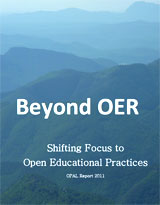
The Open Educational Quality Initiative (OPAL) released its Report 2011, entitled Beyond OER: Shifting Focus to Open Educational Practices.  Key factors:

  • Policy support for OER
  • Role of networks and partnerships for the diffusion of OER in institutions
  • Demand for specific quality assurance processes for OER

The report notes that building trust in OER would help increase the actual usage of OER in combination with open learning architectures in order to transform learning.

OER is reported to have an effect on institutional innovation culture, in higher education as well as in adult education institutions. It may thus be concluded that, regardless of educational professionals considering OER to be important for themselves or for others (e.g., students), the lesser the fear, insecurity or discomfort vis-a-vis OER, the higher the frequency of OER use. As regards the existence of open resources’ programmes or initiatives in the institution, individuals from institutions where such programmes/initiatives already exist did show a higher frequency of OER use.

The report is divided into sections to elicit macro and micro factors to explain the slow uptake of OER within organisations:

  1. A policy environment for supporting the usage of OER is important
  2. Institutional support strategies are fostering open educational practices
  3. Networks of Innovation play an important role for shaping OER developments and open educational practices
  4. Specific quality assurance processes for OER are viewed necessary
  5. Open educational practices are supported through cultures of innovation and in turn provide innovation in organisations

To read full report click here [pdf].

education and back to the future

Marina Gorbis is Executive Director of Institute for the Future takes us on an audio tour of the education landscape of the future in the context of larger technological and organizational shifts. She talks about how we can “socialstruct” education–bringing together the best technologies and online resources for the purpose of creating social interactions and environments most conducive to learning. Think Socratic education in the age of the Internet.

You may listen to her audio presentation here