
Today is the UN World Refugee Day and it is being broadcast live on UNCHR’s website. It includes interactive Twitter and chat so join in if you want.
The site is at UNCHR
Today is the UN World Refugee Day and it is being broadcast live on UNCHR’s website. It includes interactive Twitter and chat so join in if you want.
The site is at UNCHR
I am attending State of Play conference in New York. The opening speech was interesting – by the creator of Metaplace. Here are some highlights of what he said:
Raph Koster: A New Kind of World
Where is virtual world’s relevance? Virtual worlds are web 1.0 not even 2.0 not to mention 3.D. Why does the web work today? Because it is open: html, online Mozilla, apache, CGI, CSS, DNS, Google. The biggest underlining assumption is that everyone can do what they want. Virtual Worlds don’t work this way. It is a network and does not run on a single centralized server. Can they become relevant and can they break out of the plateau? When will VWs become more like the web? Metaplace tries to do that – it leaves open template content, etc. Problem is, we don’t know if anybody cares. What is the killer app for VW? It is wasting time and having fun – not education nor distance collaboration.
Do users care that they are beyond entertainment? What does it mean to build that? How do we evolve our thinking? If we actually give users the ability to work it as the web [not centrally managed, not on a single server etc].. how do we think about commerce? Eulas? Privacy?
Metaplace TOS: gives rights of creators and rights of users unless overridden, responsibilities of creators and users. It is rights of avatars. Freedom of expression, ownership, including earning money and running their own world, privacy, develop their own TOS. The declaration of the rights of avatars is now in place. They told users not to break the law. This was of course challenging.
Could we have this any other way? What areas are public? What things are private? What about people hopping across worlds? Which TOS do they belong to?
Modeling after the web: hotlinking or deep linking for example could it be the same when avatars are actually walking around through links?
Future: what will VWs be?
Looking for the new model. Old worlds will not go away but there will be a change. If they are to be relevant, how much can they emulate the web and take down countries [as did Twitter].
Talk by Teemu Leinonen [from Finland]
Two trends:
Mobiles:
Half of the world population will be using mobile phones and multimedia phones and will never reach the other types because they are very expensive.
Entry level mobile phones have:
They could stand about two weeks without charging.
The Second mobile phone: [multimedia phone – Nokia is best]
Mobile phone is one-to-one media.
Wikis:
how many have used it? How many have edited articles in wiki?
It currently has 1600 administrators for the English wikipedia. It is global.
Wikis are many to many media.
If we combine them it would be more powerful. Many to many media becomes a forum for discussion and build knowledge together in a certain shared space.
2- Mobile wikis: Mobile Audio Wiki Video
MobilEd in South Africa. It is a mobile initiative. They created an audio encyclopedia.
They tried it out in an educational setting. You can also record your own entries and it creates a podcast for you.
Mobile many to many media?
Why people want to do media? Because they can: they have the tools and time.
3- Future of mobiles in learning:
the ability for more people to talk to each other.
Informal learning: communication, news, ads
Launched in China in 2007 MobilEdu provides wireless learning directly to your device.
Nokia has Nokia Life Tools: access to agriculture, education, entertainment. It was launched in India.
OtaSizzle: ubiquitous social media for urban communities. .Oopen experimentation environment for testing mobile social media services.
Shedlight concept: [shed light application which enables people to place notes] made in a new media and learning workshop 2006 in media lab Heslsinki. You move the phone and take video of the scenes around you and people can connect to it and annotate it.
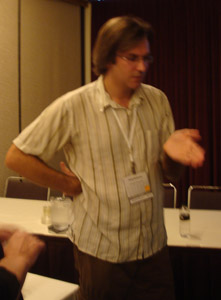
One of the best talks I attend was Greg Reihman’s teaching well with innovative technologies. Here is a brief of what he said:
No discussion of particular technologies but think about what it is we want to do when teaching. How do we plan a course or help others do that to use technology effectively? Was teaching humanities [studied philosophy]. How do we make a session better? The program he is in is called the LeHigh Lab. On a paper: Think of a specific course. What is one thing your students aren’t learning as well as you would like them to learn? What technology are you thinking about putting to use to help solve that problem?
Designing classes:
Worst countries to be a blogger in: CPJ announced its worst ten countries for bloggers… and guess how many are in the Middle East?
Relying on a mix of detentions, regulations, and intimidation, authorities in Iran, Syria, Saudi Arabia, Tunisia, and Egypt have emerged as the leading online oppressors in the Middle East and North Africa. link
Nice. Congrats Middle East, you broke a record. Again.