This slideshow with narration is from CPJ [Committee to Protect Journalists]. link

This slideshow with narration is from CPJ [Committee to Protect Journalists]. link
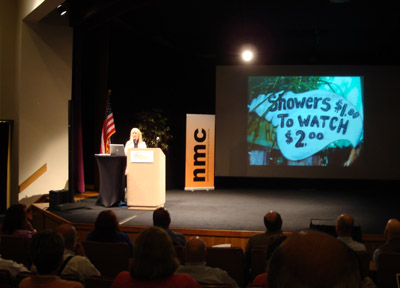
I am in Monterey, C A attending this conference. The plenary session was outstanding – the speaker, Kathy Sierra is a charismatic, hilarious and informed speaker. Love the talk. Here are the notes from that session which she called ‘Cognitive Seduction’:
Predictor of success: which is better is it how great the company is or how great the product is? How great the author is, or how great the author is? The answer is C which is talk about the user or the audience or the reader. What the testimonials are.. here is what I learnt from this product. Companies need to learn how to elicit first person language. It is all about how cool the technology is – but really how cool the user is who uses that technology, “What do you want to be really really good at? Imagine if we could actually do that for people. Why is it that the experience of being good at something is so powerful for people? How do you create passionate users? Creating hi-res user experience. Nobody is passionate about things they suck at. There is a suck threshold and a passion threshold.. one goes from beginner to expert. How do you get someone up the curve more quickly from bad to expert?
But it’s not about the tools we build. Don’t focus on the tools – people don’t want to be passionate about how good they are at tools but about what they are able to do with it. Let’s help them get really good at something. Just one problem.. your brain. Your brain and mind are in an epic battle. Brain wants food and sex but mind wants other things. The brain is filtering everything that is coming at it and trying to decide what to let through. The brain pays attention to chemistry: that which we feel., When we feel it we become passionate about it. Look at expressions of people and things and how we react to them passionately. There are many cheap tricks to get the brain to care.
The brain does not react to smiley tablet using computer. The brain does not like code because it is not life threatening. Yes you wake up the brain but sometimes for the wrong feelings.
Conversation beats formal and lecture tone. Talk to the brain not the mind. Using ‘I’ and ‘you’ makes people pay attention more because the brain thinks it is in a conversation.
Ten tricks:
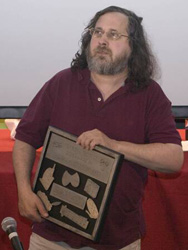 I took several of my WDIM students from my GNU/Linux class to attend Stallman’s Libre Planet, a conference organized at the Harvard Science Center by the Free Software Foundation on March 21-22. In addition to presentations from FSF staff and board members the event included a full “unconference” day of work oriented toward progressing free network services and other areas important to the free software community as outlined on the FSF’s High Priority Projects list.
The Free Software Foundation, founded in 1985 by Richard Stallman, is dedicated to promoting computer users’ right to use, study, copy, modify, and redistribute computer programs. The FSF promotes the development and use of free (as in freedom) software — particularly the GNU operating system and its GNU/Linux variants — and free documentation for free software. The FSF also helps to spread awareness of the ethical and political issues of freedom in the use of software.
The students were particularly ‘start-struck’ when Stallman appeared and gave a two minute talk and were disappointed that he left afterwards and that they did not get to hear him personally. They were looking forward to it. In any case, their feedback was great regarding the first day but were not really interested in the second day of the unconference.
As Executive Director of Virtual Activism, I was interviewed on SLCN TV for the work I have done in Second Life. The interview discussed Virtual Activism activities in Second Life as well as the creation of a replica of the St. Catherine’s Monastery in the Sinai, which had already been reviewed in the media before. To learn about the interview click here, and to see the interview click on the video below:
[youtube=http://www.youtube.com/watch?v=ODxS_VG4AXc]
Educause and NERCMP [Northeast Regional Computing Program] organized a confence in Rhode Island, March 10-12 2009 entitled Creative Intersections, Wise Collaborations, and Sustainable Technology. The conference explored how the many challenges in higher education IT form crossroads of opportunity for educators to work together across campuses, and with peers in other institutions across the country, to find sustainable solutions and best practices for today and tomorrow. Discussions revolved around teaching and learning to enterprise systems and from e-research support to IT leadership. The conference was also a great opportunity to network with peers across US campuses.
Here are the sessions I attended and some details from that conference:
I- First Session:
The Cite is Right [Dartmoth College presentation]
Lessons:
II- Second Session [2-2.50 pm]Room 553
Web 2.0 Information Literacy: Wikis for Engaged Learning: using online collaboration to investigate cases and build knowledge
Presenter: Jay Fogleman, URI and Mona Anne Niedbala
How do educators capitalize on students’ comfort with ubiquitous online tools to leverage critical thinking and strengthen their information literacy skills?
Using wikis for research, collaboration, critical thinking and knowledge building.
Babson college presentation
Used Confluence as wiki platform.
III- Third Session: 3-3.50 pm – Room 551
Twitterpated by Twitter and Other web 2.0 technologies for instructional purposes
presenter: Alexandra Pickett – SUNY
How available technologies like Twitter were used in a summer online course and can be used to enhance instruction.
Map of the world 2.0
To be more effective
Her best tools: seesmic, jing, youtube quickcapture, diigo, polldaddy, mogulus
IV- Fourth Session: 4.35-5.25 – Room 551
The mapping controversies web directory: harnessing students’ collective intelligence