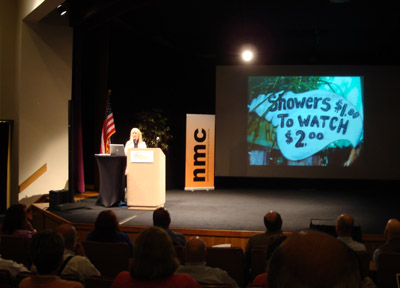
NMC: Mobiles in Learning, Socio-Economical Development and Knowledge Work

Talk by Teemu Leinonen [from Finland]

  • Finland has 5.2 million population and 6 million cellular phone subscriptions and 2 million broadband connections.
  • In 2007 Apple Computers Inc. dropped the name Computers and is now Apple Inc. because it does better now with mobile phones.
  • Annually about 1 billion mobiles phones are sold
  • 50% of the world have the basic type of mobile phones

Two trends:

  1. >mobiles and wikis
  2. Mobile wikis
  3. Future of mobiles in learning

Mobiles:

  • phones
  • multimedia phones
  • handheld devices – ipods, games etc.
  • phone computers [eg. Iphone]
  • internet tablets
  • ultralight laptops

Half of the world population will be using mobile phones and multimedia phones and will never reach the other types because they are very expensive.

Entry level mobile phones have:

  • text and talk [sms]
  • clock/alarm
  • calculator
  • torch/flashlight
  • mobile network

They could stand about two weeks without charging.

The Second mobile phone: [multimedia phone – Nokia is best]

  • talk and text
  • music/audio – mp3/FM radio
  • camera: photo and video
  • you can write software for that such as java/python, flash light etc.
  • mobile network – Bluetooth that helps sharing in close networks without much expense

Mobile phone is one-to-one media.

Wikis:

how many have used it? How many have edited articles in wiki?

It currently has 1600 administrators for the English wikipedia. It is global.

Wikis are many to many media.

If we combine them it would be more powerful. Many to many media becomes a forum for discussion and build knowledge together in a certain shared space.

2- Mobile wikis: Mobile Audio Wiki Video

MobilEd in South Africa. It is a mobile initiative. They created an audio encyclopedia.

They tried it out in an educational setting. You can also record your own entries and it creates a podcast for you.

Mobile many to many media?

Why people want to do media? Because they can: they have the tools and time.

3- Future of mobiles in learning:

the ability for more people to talk to each other.

Informal learning: communication, news, ads

Launched in China in 2007 MobilEdu provides wireless learning directly to your device.

Nokia has Nokia Life Tools: access to agriculture, education, entertainment. It was launched in India.

OtaSizzle: ubiquitous social media for urban communities. .Oopen experimentation environment for testing mobile social media services.

Shedlight concept: [shed light application which enables people to place notes] made in a new media and learning workshop 2006 in media lab Heslsinki. You move the phone and take video of the scenes around you and people can connect to it and annotate it.
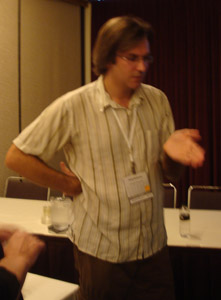

NMC 2009: Teaching Well with Innovative Technologies

Greg Leihman
Greg Leihman

One of the best talks I attend was Greg Reihman’s teaching well with innovative technologies. Here is a brief of what he said:

No discussion of particular technologies but think about what it is we want to do when teaching. How do we plan a course or help others do that to use technology effectively? Was teaching humanities [studied philosophy]. How do we make a session better? The program he is in is called the LeHigh Lab. On a paper: Think of a specific course. What is one thing your students aren’t learning as well as you would like them to learn? What technology are you thinking about putting to use to help solve that problem?

Designing classes:

  1. plan backwards: Outcomes: don’t think of you as instructor but think of the outcomes, learning objectives. What do you want students to do when they take your class? What will they learn to do? Think in term of verbs. Putting it out to them in their language. Assessment: what tools will you use to know if they learnt what they needed [quizzes, tools etc.] Activity: what will they DO to learn with their minds and bodies to gain those skills? The primary activity is they listen and they sit. Or they could do other things that could push us to a higher order of things: ruminating, creating, analyzing, debating, thinking, comparing, debating, writing, visualizing, critiquing, applying, evaluating, reading. Think of things they will do alone and others they will do with others. In the presence of instructor they usual listen and sit, but the others are done away from faculty member. When they get stomped when they are alone or with their peers, how far away will you be to offer support? All these things need to match up. Create a week on a paper and say for example on Tuesday they will listen and Thursday they will discuss – or have discussion on Tuesday and then follow up discussions on Thursday. How about writing? Use informal writing assignments – eg in blogs.
  2. What’s hard about teaching a seminar? Preparation, participation, depth Participation 30%, Final Project 20%, Paper 2 analytic Essay, Online Journal 15%, Paper 1 Comparative Essay 15%. There needs to be a midterm assessment and individual feeback that they do about themselves and that you help through. Setting up forums is important and bringing topics from that forum into the class is useful especially because you can draw in shy students. Using audio with the forum is great because you are not involved in the forum where students will start addressing you instead of each other. Ask them about the one post that they found generated comments. Now they are not only participating in the forums but they are also thinking about what makes a good conversation. Monday: lecture; Tuesday Read; online group discussion; Wednesday: write a question based on what the students wrote on the forum. Group discussion summary that I write and then give it to other groups for them to comment on. They come up with discussions for the groups. So group 4 takes the summary of group 14’s responses and come up with questions of their own to that group.
  3. Find a ‘conceptual splinter’: they are divided into groups of 5 and they bring one thing to class that they are puzzled about the following time and share what they were talking about. We took that splinter and passed it to another group. Then find a way to remove splinter: how do you make sure they all make the work? They need to write it down and at the end of the class he collects them all. Then they come back together and pick the three best solutions and from those three they need to pick one that is most plausible: which one makes a good logical argumentation? Inside the wiki he wrote the four speculations and why each is not a good answer and then one that makes sense and why. And then he writes his own comments at the bottom of the page. Knowledge survey: he asks them 20 questions in the beginning and writes their answers in a graph – the question is: could you give a philosophically sound response to this question – rate it from 0-5 in terms of confidence. Then at the end of the semester give them the same 20 questions and then put it all in a graph that starts from No confidence to complete confidence.
  4. Team teaching: bring out the sheet you wrote and see if particular technologies fit with your course and what you want to achieve.

worst places to be bloggers

Worst countries to be a blogger in: CPJ announced its worst ten countries for bloggers… and guess how many are in the Middle East?

Relying on a mix of detentions, regulations, and intimidation, authorities in Iran, Syria, Saudi Arabia, Tunisia, and Egypt have emerged as the leading online oppressors in the Middle East and North Africa. link

Nice. Congrats Middle East, you broke a record. Again.

New Media Consortium 2009 summer conference

Kathy Siera as NMC Keynote Speaker

I am in Monterey, C A attending this conference. The plenary session was outstanding – the speaker, Kathy Sierra is a charismatic, hilarious and informed speaker. Love the talk. Here are the notes from that session which she called ‘Cognitive Seduction’:

Predictor of success: which is better is it how great the company is or how great the product is? How great the author is, or how great the author is? The answer is C which is talk about the user or the audience or the reader. What the testimonials are.. here is what I learnt from this product. Companies need to learn how to elicit first person language. It is all about how cool the technology is – but really how cool the user is who uses that technology, “What do you want to be really really good at? Imagine if we could actually do that for people. Why is it that the experience of being good at something is so powerful for people? How do you create passionate users? Creating hi-res user experience. Nobody is passionate about things they suck at. There is a suck threshold and a passion threshold.. one goes from beginner to expert. How do you get someone up the curve more quickly from bad to expert?

But it’s not about the tools we build. Don’t focus on the tools – people don’t want to be passionate about how good they are at tools but about what they are able to do with it. Let’s help them get really good at something. Just one problem.. your brain. Your brain and mind are in an epic battle. Brain wants food and sex but mind wants other things. The brain is filtering everything that is coming at it and trying to decide what to let through. The brain pays attention to chemistry: that which we feel., When we feel it we become passionate about it. Look at expressions of people and things and how we react to them passionately. There are many cheap tricks to get the brain to care.

The brain does not react to smiley tablet using computer. The brain does not like code because it is not life threatening. Yes you wake up the brain but sometimes for the wrong feelings.

Conversation beats formal and lecture tone. Talk to the brain not the mind. Using ‘I’ and ‘you’ makes people pay attention more because the brain thinks it is in a conversation.

Ten tricks:

  1. Focus on what the user does, not what you do. Exercise: don’t build a better x but ..
  2. Give them superpowers, quickly. Give them something that empowers them quickly. User must do something cool within 30 minutes.
  3. Make them smarter: what makes you smarter? Brain games? Puzzles? Those help a little – but aerobic exercise improves your brain capabilities. Exercise is the poor man’s plastic surgery.Stand up and improving your balance makes you smarter because the brain is trying to keep you balanced and upright. Those are the kinds of things we need to think for our users.
  4. Don’t focus on X, ask what X is a subset of. Find relevance. What is the bigger thing that your topic is a part of? Eg. Don’t blog about your product but about what people can do with it – it is about cooking, not the tool.
  5. Shrink the 10,000 hours. There are ways to shrink the 10 thousand hours to be good at something: learn the patterns, shorten the duration by helping them do them in a shorter period of time. Create and think in patters and chunking. Learn to do knowledge acquisition. Always be practicing. Create a culture of practice. We expect people to practice [athletes etc], but for software development we don’t have that culture. Only a thousand is needed to be expert. Experience is a poor predictor of performance/expertise. Offer exercises, games, contests, tutorials tht support deliberate practice of the right things.
  6. Make your product or docs reflect their feelings. Reflect the way people are using it. Help and FAQs are not effective. We write it for happy smiley people but not beginners. “Letting people off the hook is the killer app”. People should not be made to feel guilty and bad. How you make them feel about themselves drives how they feel about you.
  7. Create a culture of support. How do you ger them to answer and ask questions? There are no dumb questions. In communities people have to make people feel comfortable asking questions. No dumb answers too. We have to allow people to feel that it is ok to answer wrong. That’s part of how they learn.
  8. Do not insist on inclusivity. Passionate users though talk different. Part of what is cool is to be able to talk in jargon inspite of the presence of newbies.
  9. Make the right thing easy, wrong thing difficult. A treadmill is not in the corner because you don’t use it but you don’t use it because it’s in the corner. Make is easier for users to breakthrough.
  10. Total immersion jams: 16 hours over two days vs. 16 hours over two months. Compressed periods of time are better for creativity breakthroughs. The surest way to guarantee nothing interesting happens is to assume you know exactly how to do it.
  11. Be brave. Love is good, hate is good but in the zone of mediocrity you’re scrwed.