who’s afraid of bill gates?

bill_gates_halo_3.gifThe Scientific American is reporting that Microsoft’s Bill Gates is at it again: he is attacking open source and says it is violating 235 icsoft patents [link]. This is of course in response to the way Linux has been gaining ground and taking away from Microsoft’s market share. Apparently Microsoft sent an email to reporters this past Monday detailing its position which it had previously written in Fortune Magazine.

According to another source, patent experts say that

Microsoft’s patent complaints don’t make a lot of sense from a legal standpoint. The complaints, while possibly driving some customers away from open-source software, may make Microsoft the target of lawsuits from open-source developers seeking to prove they have not infringed, some patent experts have said.

Among those,

open-source advocates, including Linux creator Linus Torvalds and long-time open-source advocate Eric S. Raymond, have said there’s a simpler explanation for Microsoft’s action: It’s trying to create fear, uncertainty and doubt about open-source software.[link]

So.. don’t be afraid of Microsoft’s threats.

portrayl: is there a story inside you?

Two new and interesting online tools that I found listed on techcrunch: Portrayl and Ficlets. Both allow you to create a collaborative story.

Portrayl , according ot their website “is a place where writers showcase their work. You can start a story and add a chapter at a time. When you decide you’re finished, you can create a pdf ebook and also rss feeds of your story. Here’s the cool part – other people can add chapters to your story – but your chapters stay intact. When someone adds to your story it branches off into a new direction.

portrayl.gif

Ficlets: according to their site “a ficlet is a short story that enables you to collaborate with the world. Once you’ve written and shared your ficlet, any other user can pick up the narrative thread by adding a prequel or sequel. In this manner, you may know where the story begins, but you’ll never guess where (or even if!) it ends.”

ficlets.gif

Cool huh?

the ghost in the browser

google.gif

Google just released a study entitled The Ghost in the Browser: Analysis of web-based malware [pdf document] in which it claims that 10% of websites contain malicious malware. It conducted an “in-depth research on 4.5 million Web sites and found that about one in 10 Web pages could successfully “drive-by download” a Trojan horse virus onto a visitor’s computer. Such malicious software potentially enables hackers to access sensitive data stored on the computer or its network, or to install rogue applications.” [cnet news]

Not only that, but according to another article on cnet,

An average of 8,000 new URLs containing malicious software emerged each week during April, Cluley said, adding that the notion that such software resides only in the darker corners of the Internet is very outdated. Seventy percent of Web pages hosting rogue software are found on legitimate sites targeted by hackers, according to Sophos.

report: net censorship increases around the world

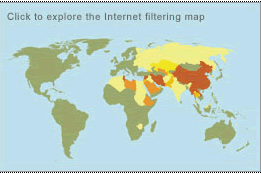
The BBC reports that the Open Net Initiative at Harvard University in the US has just released a report about internet censorship across the globe. It claims that net censorship has increased and that the problem about that is that net filtering always happens in the dark. There is no way one can find what is being filtered or what is being censored. Evidence of this censorship was found in the following countries: Azerbaijan, Bahrain, Burma/Myanmar, China, Ethiopia, India, Iran, Jordan, Libya, Morocco, Oman, Pakistan, Saudi Arabia, Singapore, South Korea, Sudan, Syria, Tajikistan, Thailand, Tunisia, Turkmenistan, UAE, Uzbekistan, Vietnam and Yemen.

In particular, the report conducted research in the MENA region and it states:

filteringmap.gifONI conducted in-country testing for Internet filtering in sixteen countries in the North Africa and Middle East region. .. eight of these countries broadly filter online content: Iran, Oman, Saudi Arabia, Sudan, Syria, Tunisia, United Arab Emirates, and Yemen. Another four—Bahrain, Jordan, Libya, and Morocco—carry out selective filtering of a smaller number of Web sites. ONI found no evidence of consistent technical filtering used to deny access to online content in Algiers, Egypt, Iraq, or Israel. [link]

attempted thinking

US Attorney General Alberto Gonzales is proposing a new bill that would “increase criminal penalties for copyright infringement, including “attempts” to commit piracy.” [link]
Apparently the Bush administration is supporting the bill which is entitled  the Intellectual Property Protection Act of 2007 [link to pdf of the bill]. Naturally, the intellectual property laws are aimed at protecting big music and movie industries.

Here are some of the proposed measures in the law:

  • Criminalize “attempting” to infringe copyright. Federal law currently punishes not-for-profit copyright infringement with between 1 and 10 years in prison, but there has to be actual infringement that takes place.
  • Create a new crime of life imprisonment for using pirated software.
  • Permit more wiretaps for piracy investigations.
  • Allow computers to be seized more readily.

What’s next? criminialize ‘attempted thinking’?